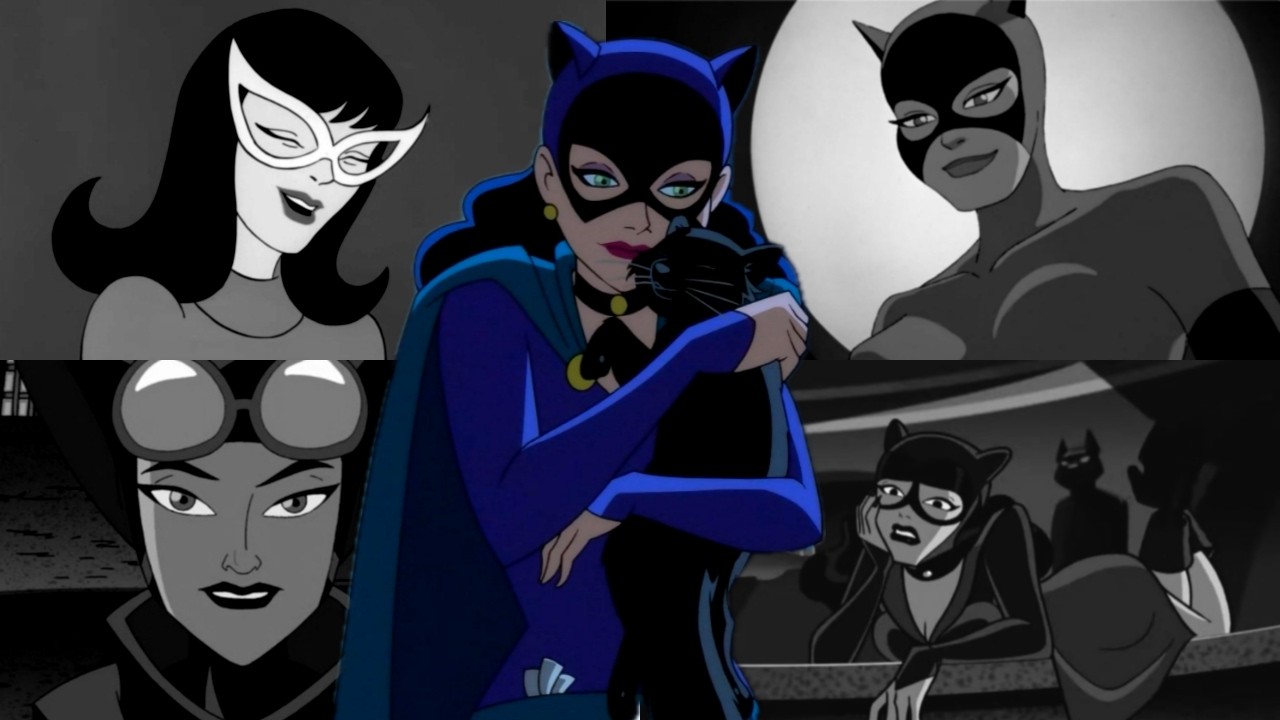
Black Cat: The Thief with a Heart of Gold
Introduction
Black Cat, also known as Felicia Hardy, is one of Spider-Man’s most complex and intriguing supporting characters. Created by Marv Wolfman and Keith Pollard in “The Amazing Spider-Man” #194 (1979), she has evolved from a simple cat burglar to a multi-faceted character who often walks the line between hero and villain. This analysis examines Black Cat’s portrayal across Spider-Man animated series, exploring how different adaptations have interpreted her character, relationships, and evolution while highlighting her significance as a unique figure in the Spider-Man mythos.
The Evolution of Black Cat
Early Appearances (1990s)
- Spider-Man: The Animated Series (1994-1998)
- Characterization: The first animated portrayal of Black Cat
- Portrayal: Introduced as a cat burglar with a personal vendetta against Kingpin
- Personality: Confident, flirtatious, and independent
- Voice Acting: Jennifer Hale delivers a standout performance, capturing Black Cat’s confidence and allure
- Significance: Becomes a recurring character with a complex relationship with Spider-Man
Modern Adaptations (2000s-Present)
-
Spider-Man: The New Animated Series (2003)
- Characterization: Makes a brief appearance in this series
- Portrayal: Still primarily defined by her role as a cat burglar
- Personality: Shows hints of her complexity but remains largely focused on her criminal activities
- Significance: Remains a supporting character with potential for future development
-
The Spectacular Spider-Man (2008-2009)
- Characterization: One of the most nuanced portrayals of Black Cat
- Portrayal: Introduced as Felicia Hardy, Peter’s classmate, before becoming Black Cat
- Personality: Shows Felicia’s confidence and independence, and Black Cat’s skill and cunning
- Voice Acting: Tricia Helfer delivers a standout performance, capturing Black Cat’s confidence and allure
- Significance: Becomes a recurring character with a complex relationship with Spider-Man
-
Ultimate Spider-Man (2012-2017)
- Characterization: Makes several appearances throughout the series
- Portrayal: Initially depicted as a villain, but later shows hints of anti-heroic tendencies
- Personality: Shows her confidence, skill, and occasional moments of heroism
- Significance: Evolves from a villain to a reluctant ally
-
Spider-Man (2017-2020)
- Characterization: Introduced as Felicia Hardy, a skilled thief
- Portrayal: Emphasizes her skill as a thief and her complex relationship with Spider-Man
- Personality: Shown as confident, independent, and slightly mischievous
- Voice Acting: Erica Lindbeck provides a modern, nuanced voice for Black Cat
- Significance: Established early as a character with potential for future development
Core Personality Traits
Consistent Traits Across Adaptations
Black Cat’s character is defined by several key traits that remain consistent across adaptations:
- Confidence - Black Cat is typically portrayed as extremely confident, bordering on cocky
- Independence - She values her independence above all else
- Skill - She is a highly skilled thief with exceptional agility and stealth
- Flirtatiousness - She often uses her charm and flirtatiousness to her advantage
- Moral Ambiguity - She walks the line between hero and villain, often doing what benefits her most
Evolving Traits
As Black Cat’s character has evolved, certain traits have been emphasized or expanded upon:
- Complexity - Modern adaptations often highlight the complexity of her character and motivations
- Heroic Tendencies - Recent portrayals emphasize her potential for heroism
- Emotional Depth - Some adaptations explore her emotional vulnerabilities more deeply
- Loyalty - Modern adaptations often show her developing genuine loyalty to Spider-Man and his allies
The Origin Story
Across all animated adaptations, certain elements of Black Cat’s origin remain consistent:
- The Motivation - Felicia Hardy becomes Black Cat to avenge her father or to follow in his footsteps
- The Training - She undergoes extensive training to become a skilled thief
- The Equipment - She uses various tools and gadgets, including grappling hooks and night vision goggles
- The Conflict - She comes into conflict with Spider-Man, who opposes her criminal activities
Variations in the Origin
Different adaptations have introduced variations to Black Cat’s origin:
- Her Father’s Influence - The extent to which her father influences her decision to become a thief varies
- The Training - The details of her training and how she acquires her skills vary
- The Timeline - The timing of her transformation into Black Cat relative to Spider-Man’s origin varies
- The Aftermath - The immediate aftermath of her transformation into Black Cat is depicted differently
Relationships
Peter Parker/Spider-Man
-
Evolution of the Relationship
- Early Adaptations: Often starts as a straightforward adversarial relationship
- 1994 Series: Explores the complexity of their relationship, with moments of both conflict and attraction
- Modern Adaptations: Shows a more nuanced relationship with moments of both antagonism and genuine connection
-
Dynamic
- Cat-and-Mouse: Their relationship often takes on a cat-and-mouse dynamic
- Attraction: There is often a romantic tension between Black Cat and Spider-Man
- Moral Conflict: Their differing moral codes create conflict
- Growth: Their relationship often shows growth over time, with Black Cat occasionally helping Spider-Man
-
Discovering the Secret Identity
- Timing: In some adaptations, Black Cat discovers Peter’s secret identity
- Reaction: Her reaction varies from surprise to amusement, often with a period of adjustment
- Impact: The discovery typically changes their relationship significantly
- Involvement: Some adaptations show her becoming more involved in Peter’s personal life
Other Relationships
-
Her Father
- Early Adaptations: Often portrayed as a criminal who influences her decision to become a thief
- Modern Adaptations: Shows a more complex relationship, with moments of both admiration and conflict
- Impact: Her father’s influence is often a key factor in her decision to become Black Cat
-
Other Villains
- Alliances: Black Cat often forms temporary alliances with other villains
- Betrayals: She is not above betraying her allies if it benefits her
- Rivalries: She often has rivalries with other thieves and criminals
-
Spider-Man’s Allies
- Tension: Spider-Man’s allies often view Black Cat with suspicion
- Growth: Over time, some of Spider-Man’s allies come to trust Black Cat
- Team-Ups: She occasionally teams up with Spider-Man’s allies to face common threats
Motivations and Goals
Primary Motivations
Black Cat’s motivations typically fall into several categories:
- Personal Gain - She is often motivated by personal gain, particularly wealth
- Revenge - She sometimes seeks revenge against those who have wronged her or her family
- Freedom - She values her freedom above all else and resists any attempts to control her
- Challenge - She is motivated by the challenge of pulling off difficult heists
- Connection - She sometimes seeks genuine connection with Spider-Man
Evolving Motivations
As Black Cat’s character has evolved, her motivations have become more complex:
- Heroic Impulses - Modern adaptations often show her acting on heroic impulses
- Loyalty - She sometimes puts loyalty to Spider-Man above her own self-interest
- Redemption - Some adaptations explore her desire for redemption
- Purpose - She often seeks a greater purpose beyond simply stealing
Cultural Impact and Legacy
The Anti-Heroine
- Complexity - Black Cat represents one of the most complex female characters in the Spider-Man mythos
- Independence - She embodies female independence and agency
- Influence - Her portrayal has influenced subsequent female anti-heroes in popular culture
- Relevance - Her character continues to resonate with audiences, particularly as discussions about gender and representation in media have grown
Influence on Other Media
-
Comic Books
- Animated portrayals have influenced how Black Cat is depicted in comics
- The depth of her character in animation has led to more complex portrayals in comics
-
Live-Action Films
- Elements of her animated portrayals have been adapted in live-action films
- Her character has been referenced in the MCU
-
Video Games
- Black Cat has appeared in numerous Spider-Man video games, often drawing inspiration from her animated portrayals
- She is often a playable character or a major supporting character
Fan Engagement
- Popularity - Black Cat consistently ranks among the most popular female characters in the Spider-Man mythos
- Fan Works - She has inspired numerous fan works, including art, fiction, and cosplay
- Merchandise - She is a popular character for merchandise, often featuring her distinctive costume
- Recognition - She is widely recognized as one of the most iconic female characters in superhero media
Voice Acting Legacy
Notable Voice Actors
- Jennifer Hale (1994-1998) - Delivered the definitive portrayal of Black Cat for a generation, capturing her confidence and allure
- Tricia Helfer (2008-2009) - Provided a nuanced performance that captured both Felicia’s vulnerability and Black Cat’s confidence
- Grey Griffin (2012-2017) - Delivered a modern take on Black Cat in “Ultimate Spider-Man”
- Erica Lindbeck (2017-2020) - Provided a fresh, nuanced voice for Black Cat in the 2017 “Spider-Man” series
Impact of Voice Acting
- Character Identity: For many fans, the voice actors’ performances define their perception of Black Cat
- Emotional Connection: The voice actors’ performances help fans connect with Black Cat on an emotional level
- Consistency: Despite different interpretations, certain vocal qualities remain consistent, such as her confidence and flirtatious tone
- Evolution: The voice acting reflects the evolution of Black Cat’s character over time, from simple cat burglar to complex anti-heroine
Conclusion
Black Cat has evolved significantly across Spider-Man animated series, transforming from a simple cat burglar to one of the most complex and compelling female characters in the Spider-Man mythos. Her journey reflects broader changes in how female characters are portrayed in superhero media, as she has grown to become a fully realized character with her own motivations, complexities, and moments of heroism.
What makes Black Cat so compelling is her combination of confidence, independence, and moral ambiguity. She is a character who does what benefits her most, but who also has a strong sense of loyalty to those she cares about. Her relationship with Spider-Man is particularly interesting, as it walks the line between attraction and conflict, highlighting the complexity of both characters.
As Spider-Man animated series continue to evolve, Black Cat’s character will undoubtedly continue to develop, reflecting changing cultural attitudes and storytelling trends. However, the core elements that make her so beloved—her confidence, her independence, her moral ambiguity, and her complex relationship with Spider-Man—will likely remain constant, ensuring her place as one of the most iconic characters in the Spider-Man mythos.
Black Cat is proof that female characters in superhero stories can be more than just love interests or sidekicks; they can be complex, independent figures with their own motivations and struggles, whose stories can be just as compelling as those of the heroes they interact with.